
Do you ever rant to your friends? Go on and on about how you were wronged? Part of you might think you just do this to get it all out of your system but another, deeper reason, is you do it to pick their mind. To get a new opinion, to validate or contradict you, to see it from a new perspective.
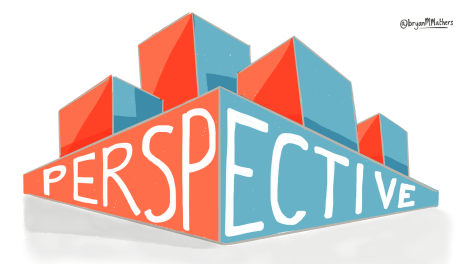
In chapter four of Perceptions and Language Issues in the Mass Media the authors aim to shed light on the psychology on how we perceive different situations and media. The central point of their argument all comes back to the fact that it’s all relative. Our cultures, personalities, moods; these all make up how you might perceive something versus how someone else might.
Walking into a friends home for the first time, you can truly get what it’s like to be submerged into a whole new culture. Shoes are fine in my house but not in hers, I don’t have explicitly stated chores but at his house he has five, and so on. Where my wearing shoes in her house would be perceived as rude or inconsiderate at my house no one would bat an eye. The way we were raised, the society and people that surrounded us make up our set perceptions. These are our default modes, our schemas, the thoughts we have before we correct them or act on them. Education is what has the power to influence these predisposed responses.
Our personalities greatly affect how we view the world as well. If you’re a cynic you will never look at something with overwhelming joy. You see a man propose in the middle of time square and wonder how long they’ll make it before they “inevitably” get divorced. If you’re an optimist you see this same proposal and just know “with all your heart that they are going to be the 50% that does make it.”

Speaking from personal experience if I’m in a bad mood everything anyone does is sexist. It’s funny in hindsight but in the moment, what I would normal think of as kind and considerate, I perceive as misogynistic and a way to “bring the woman down!” This is of course usually wrong but not unfounded. In chapter four the authors reference the study done by Leuba and Lucas using hypnosis wherein the participants were exposed to different moods and emotions and were told to respond to the same images. The reaction to the exact same image but different moods were like polar opposites.
This study in part proved that a persons mood greatly affects how they see things. Road rage while driving and being a passenger while the driver is raging is a perfect example of this phenomenon. When you’re the driver your actions and words are perfectly validated but when you’re the passenger the “offense” of the other drivers seems more muted and less quarrelsome.
In the chapter they go on to further delve into how perception and media play a role together. They sight propaganda techniques like military commercials with target demographics and the use of satire in America. Because of all the aforementioned perceptual influences people take in propaganda and satire in entirely diverse ways. This; however, causes misinformation to be consumed as massive rates. It, like in the chapter, condones bigotry for some or dissuades from what they were trying to persuade.
Finally they highlight the fact that our brains are picky. We only hear what we want to hear. My psychology professor liked to call our minds our personal attorneys. We want to be right so sometimes our minds just exclude the stuff that contradicts us. When your mom swore, hand on Bible, that she told you to do the dishes after school and you know you didn’t hear her, well maybe that was your brain protecting you from having to do your most loathed chore.

How we perceive the world is different for everyone, the art of mastering this very self absorbed mindset is to be aware of it and to be able to look outside of your mood, personality, or culture and see what “they” are seeing. Look at the world anthropologically and ask the question “why?” That’s how we coexist, but thats just the way I see it.
 Bellamargallo
Leave a comment