I love you! But not in that way.

Text love

The other day I was walking through an open art exhibit with my friend and continuously exclaimed: “I love that!” or “I love this so much!” as I casually walked past without a second thought. Why do we so casually declare our love for things we only vaguely find appealing and why do we so carefully avoid saying those same words to the people around us?

When we declare our love for an object it is assumed, in almost all instances, that the love is surface level, fleeting. It’s just a throw away phrase and everyone knows it. “I love this painting” doesn’t mean I’m bound to this art work and now have to pay the thousands of dollars it costs. It means that I like it and I appreciate what the artist is portraying. We say “I love you” to things because there are no consequences in saying it, no follow through, no risk. “I love this” holds no value.

“Lovesick” by Banksy

Transitioning “this” to “you” however is a whole different thought process; well, kind of. Applying “you” to love and the meaning behind it depends on who “you” is referring. Speaking from experience, when referring to a group of girls, “I love you” is as interchangeable as “I love this new song.” It holds very little weight to it, mostly just said to show momentary loyalty and friendship. It’s an expected turn of phrase for women to use with each other. “I like you and you are my friend” ends up being condensed into “I love you b*tch.”

When “I love you” is applied to a man and/or significant other the gravity of the phrase grows exponentially. The meaning changes because the addition of the phrase changes the tone of the relationship. The common question couples are continually asked is “who said ‘I love you’ first?” They ask because to say “I love you” is like jumping out of a plane without a shoot, it’s a risk.

On dating apps the phrase “here for a good time not a long time” is thrown around every one or two swipes, meaning “I love you” better not come in any vicinity of that relationship. To love someone romantically cements the relationship into something more long lasting rather than a fleeting “good time.” There is a future with someone you truly love, assuming that love means something to you. There are expectations and responsibilities that come with it, whether we want love to be easy or not.

Nowadays love only has transferable meaning depending on the relationship. Love and hate, joy and depression all these words that used to be the most extreme description or feeling is now minimized to the context in which it’s used. Love could mean everything but it could also mean nothing at all.

I tend to get caught up in the interchangeable nature of such overly exhausted words without ever stepping back to really understand what I’m saying. We assign love to everyone we like to seem kind or to show that we like them. However, in this process we diminish the strength of the word all together. Today I would venture to say that telling someone you like them is more impactful. You can love anyone, take your family for example; you love them but you might not actually like them. I find it harder to tell the people around me that I like them than to tell them I love them.

Why doesn’t this say love?

We tend to love a word so much we ruin it in the process with over exposure. Words are like your favorite pair of jeans, if you wear them everyday they won’t last long, they fray and get holes. But if you save them for when you really need them they can last you your whole life. Language can do the same, it can last a lifetime if and only if we nurture and conserve it.

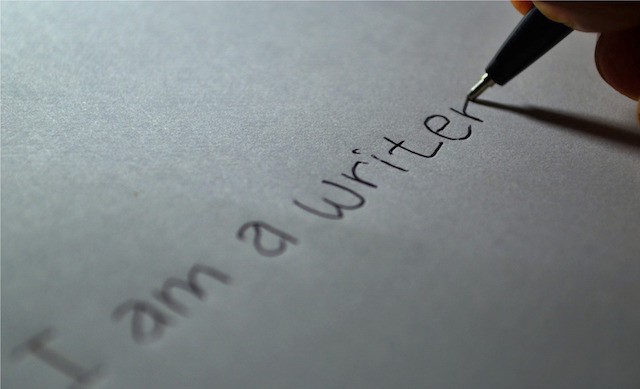
In and out of love; a writers tale

Courtesy of Google images

A creative writer and a journalist walk into a bar… My story is one of how, as usual, high school impacted my long and complicated relationship with writing. How four years in both AP level english classes and on the Coronado high school newspaper staff made me grow as a decent writer but also crippled me with self doubt and anxiety at the mere mention of it.

My love for writing began when I was 13 when my eighth grade english teacher assigned weekly journal entries. She gave us points and ideas to jump off from but for the most part she just wanted us to write; to get words and creativity on paper, to inevitably “practice what [she] preached.” I was able to finally put my thoughts and feelings into something productive and, as it turns out; I was pretty good at it. I have that journal to this day. I write in it to relieve stress or to help with my depression and anxiety or just to spit an idea onto paper without worry of what anyone else has to say about it. Grammar and spelling be damned; in between the black and white speckled cover is my sanctuary, not to be tied to any literary rule or expectation.

Aesthetically pleasing journal found courtesy of Google images

Then comes the transition of power and practice. As a self proclaimed “inquisitive writer” I wanted to look into different mediums of writing and discovered the newspaper staff at my high school. Starting as an affectionately named “newsy” I had to learn what journalistic writing was. The strict rules, the completely different style and tone, all and all: reinventing the wheel. Academic writing was the only style english teachers had taught me, journalism challenged that thought and taught me a whole new way to look through this literary art form. I also had to add law to my list of “need to knows” for journalism. Memorization of the first amendment was an absolute must as well as all the important Supreme Court cases that gave me my rights as a journalist, albeit a high school journalist. I gained a greater appreciation for how writing can be an art form with many different factions and possibilities and can even intersect with fields of distant interest.

Article and infographic done by myself for The Roar

The next three years of my journalistic experience saw the evolution of writer turned journalist turned editor turned editorialist. My writing got better and better and its subjects became more substantial. In my senior year as Features Editor, I was commenting and reporting on topics like DACA, female obesity, and the negative affects of vegetarianism as an ex-vegetarian. It was fulfilling to write about topics that actually mattered to me, even if it was just to disinterested high school students.

During this time of growing and discovery I was also struggling. What had once been my art form had become an overwhelming chore, it became a heavy burden that I no longer felt joy in carrying. In my case this was all connected to my journalism teacher. It’s true that a good teacher means all the world to a students success, so does a bad teacher.

I’m not going to try and play the blameless victim, I missed deadlines all the time and failed to do all that was required of me. I know that the grade I received in that class was the grade I deserved (a B for all those wondering). My relationship with writing wasn’t effecting because of this, this was effected because of the strain.

The Roar news staff 2016-2017

My teacher governed with emotions; if she liked you, she took you under her wing and nurtured you to help you grow. But if she didn’t like you (i.e. me) life was made very hard. Going into her coffee scented room everyday was like walking arms open into a panic attack. Critiques saved for private conversation were thrown across the bustling room at me like arrows hitting their bullseye, cross examining me at every chance she got during class discussions and all in all making me feel small. Others started noticing the ever so slight misconduct that would happen in the day to day, all the while just watching as I kept my head down, trying to dodge the arrow.

Now I know what you are all thinking. Either 1- “Why didn’t you just stop taking her class?” or 2- “Grow up, everyone has bad teachers who don’t like you. Get over it and keep on pushing on.” What you need to understand, was that I was in that class, with that same teacher, for four years of my life. By the time I even considered just quitting the staff I had already invested too much of myself into it for it to amount to nothing. I had to see it through.

So I kept going until graduation day when I left and never looked back. Even though those four years where hell for me, I can’t deny that I grew as a writer; exponentially. I’m ashamed to admit it, but that class is probably the main reason why I took the fall semester off of college. During that time however, I kept journaling, kept putting pen to paper, and reignited the passion I have for writing. But this time on my own terms.

Portrait of an Art Snob

A portrait of John Berger

Walking through an art exhibit we all become self proclaimed art critics to an audience of one. We judge art based on how we interpret it and based on what our definition of “good art” is. When we see a photo of a piece of art we do the same thing. John Berger in his short novel, Ways of Seeing, disagrees. He believes that our perception of an art work in person is vastly different from when we only see a photo of the work. He also takes it further remarking that because of the introduction of art reproduction, through photographs, even the in person viewing is tarnished as well. Berger is what I like to call; an art snob. And I should know, I was one too.

the cathedral church of st. john the divine est. 1892

Walking into The Cathedral Church of Saint John the Divine I was struck by the vastness of its beauty, its arching walls, glass panels depicting magnificent holy scenes, and small enclaves hidden behind the head of the church. It radiated greatness. But there were modern irregularities added to the church that distracted me from the ancient beauty. Modern day art had been added to the walls and placed in the centers of the rooms. There was even a makeshift gift shop placed right at the entrance where the prayer candles lay in wait. At first I was incredibly angry that someone would “defile” this holy place and cause a distraction from the pre-existant art that had been there for centuries. Then I found out why; the art was being displayed as a way to keep the church alive. It brought new people in and kept people coming (the exhibit of modern art changed every few months). My own art snobbery was checked and I was brought to the realization that sometimes the original work must be, in a way, compromised in order for it to stay relevant and flourishing.

Berger has stapled himself at the front of the technology rejection movement. A movement that blossomed when technology started changing how we experienced things. John Berger looks at art through only one lens, a lens he believes true art can only be seen and experienced through. Photography challenged that common perspective by adding in a new lens. A lens all people can look through, not just art connoisseurs, snobs, and the filthy rich.

In Ways of Seeing, Berger reiterates the importance of uniqueness in the debate of photography versus the “art experience.” Berger argues that the reproduction of art changes the meaning of the piece as a whole. He goes on to stress that the duplication of original art results in the environment influencing the meaning of the artwork “as a result its meaning changes- it’s meaning multiplies and fragments into many meanings” [19]. It’s a common belief however that artists create art for the viewer to interpret. It’s one of the artists catchphrases if you will. “It’s in the eye of the beholder” and photography doesn’t change this concept. Art impacts peoples lives in different ways no matter how we first experience it because we all come from different backgrounds and our perspectives are unique to the individual.

Banksy Nazi Canvas est 2013

Berger also separately contends that art works are now only valued for their originality and not their content. He slightly contradicts himself but all in all he is remarking that the art is “defined as an object whose value depends on it’s rarity” [21]. Going further he points out that the price a piece may go for “gauges and affirms” this rarity. Banksy is a modern day example of how this belief is untrue. This piece by Banksy was a nature painting done by a different artist that was on sale. Banksy took this artwork and discreetly added in the Nazi soldier and put it back where it was being sold. This painting, due to Banksy’s addition, sold for $615,000. The painting wasn’t known to anyone except the art world, due to the story and to the growing prestige of Banksy as a modern Van Gogh, the painting gained its lofty price tag. The story Banksy made and created for this work made it prestigiously priced, not the rarity, seeing as Banksy still creates to this day.

Adding an off topic and irrelevant example of Madonna of the Rocks by Leonardo Da Vinci Berger explains that the value of the art comes from whether or not the piece is the true original. His point is slightly lost in the schematics of explaining the Madonna that is at the Louvre and the National Gallery. (Where I found that both Madonna of the Rocks are the originals. Da Vinci made two similar paintings, both entitled Madonna of the Rocks. The Louvre piece however, was transferred onto canvas). This argument is irrelevant due to the fact that art has been duplicated for centuries, before cameras even existed. It has always, and will always, matter if the art work truly came from who it is attributed. The fame of the artist is what dictates how closely we focus of the lineage and originality of the art.

Madonna of the Rocks est 1483-1486

Finally, he also fails to recognize photography as an art in and of itself. Photography is now considered a “fine art,” it is the work to be seen. By taking apart a piece of art work and only photographing certain sections of the art the photographer is making his/her own story. They create a new life for that one-dimensional piece and allow it to have multiple stories and perspectives.

The introduction of photo reproduction of art has saved famous works of art from becoming extinct. It allows the world to appreciate the art that they might never would have had the chance to otherwise. Like the modern art exhibit in Saint John’s Cathedral, photo reproduction gives life to classic works and allows them to effect and change and already changing society.

What “They Say”

Image result for they say

In an effort to make a speech or essay interesting many authors and speakers skirt around their main point, only ever alluding to they’re true purpose. In chapter one of They Say I Say, Cathy Birkenstein and Gerald Graff attempt to fend off this misconception of intrigue over substance. They make a point to address their personal experience of confusion when their speaker “Dr. X” spouted facts and opinions on a topic he never stated. They go on to address how the speakers verbal acrobatics where mute due to his lack of directness. It’s better to be straight forward and clear, specifically in introducing your claim, than be “interesting” and leave your audience/reader lost in a haze of nonsensical points.

Contrary to what other writers and academics might preach, stating the rival sides stances and assertions can strengthen the writers/speakers argument. It defends the assumptions of the audience that the writer knows what she/he is talking about. Birkenstein and Graff go further saying “that you need to present that argument as part of some larger conversation, indicating something about the arguments of others that you are supporting, opposing, amending, complicating, or qualifying” [pg 21]. In layman’s terms; your position is just one part of a larger machine and you make that clear when stating your position. You’re letting your audience know that you are looking at one side of an argument and focusing solely on that rather than b and c. The authors also urge other authors/speakers to continually refer back to the “they say” so the audience is reminded of the topic argument but to also keep a central focused line throughout. Return sentences are crucial to keep a sense of energy and purpose throughout your writing/speech. Always clarifying what you are referring to and how it applies to that central idea. What “they say” is an essential companion to what “you say” being sure to clarify and integrate it is vital to the quality of any argumentative writing or speech.

Questions I still have: Though I understand that it’s important to refer consistently back to the “other side” I wonder if there is a good ratio to follow to insure that your argument is the main point of the piece? Rather than it being equal, making it read more like an informative piece instead of an argumentative. Is there a way to make sure I don’t cross that arguably thin line?

A new era

Testing, testing, is this thing working? Well if it is then welcome to Bellamargallo. Bellamargallo is the craft that will carry my hopes and dreams of passing English 101 at the College of Southern Nevada (CSN). I don’t necessarily know what this will become but my fingers, rusty from lack of use, are itching to stretch out across the worn keyboard once again and see what words of wonder might pop out. So we’ll see what this viewer-less sight has in store and whether it can achieve it’s destiny.

Website Powered by WordPress.com.

Up ↑

Design a site like this with WordPress.com
Get started